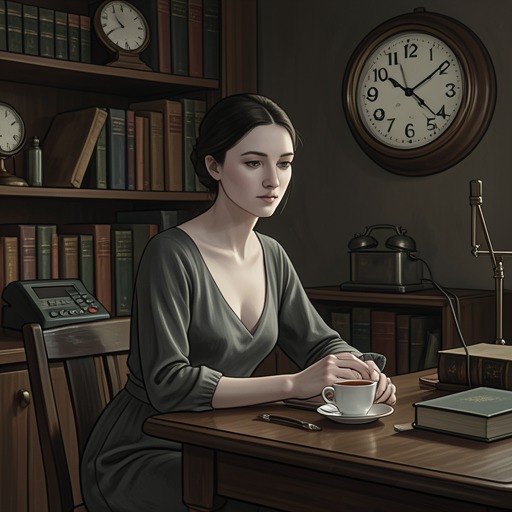
Julian Harmon
A Murder Is AnnouncedJulian Harmon, the vicar of Chipping Cleghorn, is both a devoted reader of detective fiction and a conscientious parish priest. As Diana “Bunch” Harmon’s husband, he shares her delight in a murder mystery, but his clerical work keeps him from the gathering at Little Paddocks and later draws him away when another parishioner needs attention. At the novel’s end, his response to the murder investigation gives the story one of its clearest distinctions: murder may fascinate as a puzzle, but its perpetrators remain human, pitiable, and dangerous.
Identity and Character
Julian is introduced through Bunch’s conversation at breakfast, when she reads the newspaper announcement that a murder will take place at Miss Blacklock’s house. He is surprised by the news and asks when it is supposed to happen. Bunch knows at once that the scheduled event will appeal to him: the announcement concerns a murder, and he loves murders. The scene establishes his interest through his wife’s affectionate teasing rather than through any claim that he takes part in the ensuing investigation.
The narrator describes Julian as seeming made by Nature for the age of sixty, although he is still about twenty-five years short of it. That image presents him as older in manner or appearance than his years, while his domestic scenes with Bunch reveal a more playful side. When she calls herself stupid, he contradicts her and tells her she is clever; when he observes that she is still rather like a little girl, the exchange reads as fond familiarity rather than rebuke.
Parish Duties and the Murder Announcement
Bunch regrets that Julian cannot attend the announced murder at Little Paddocks because he has preparations for a confirmation service. His absence is not lack of interest. She explains to the others that he is frantic with frustration at missing the occasion and that he adores murders. The practical demands of his vocation therefore set up a recurring contrast: Bunch can rush toward the village’s mysteries, while Julian is obliged to attend to parish work.
Bunch also recounts how a detective novel, Death Does the Hat Trick, interrupted Julian’s preparation of a sermon. She had left the book in the study, and he picked it up and could not put it down. In her account, the resulting sermon was better than usual because he had to write it quickly and state what he wanted to say plainly, without scholarly elaborations. The anecdote makes his enthusiasm more than a passing taste: detective fiction can hold his attention even when he has serious work to finish, and Bunch treats that diversion with amused affection.
Marriage and Shared Life
Bunch’s fondness for Julian is expressed in extravagant domestic hopes. When she worries that a frightening game might make her heart leap, Julian reassures her that she will live to be very old with him. She imagines them dying on the same day and being buried in the same grave, and beams at the prospect. The exchange gives their marriage a light, intimate texture, with Bunch’s imaginative exuberance met by Julian’s steady reassurance.
Their differences are affectionate rather than alienating. Bunch is impulsive and openly excitable about mysteries; Julian is often occupied by the obligations of his office. Yet they share a taste for detective stories, and their conversations repeatedly make that shared interest part of married life. At the vicarage after the case is resolved, Bunch sits on the floor near the fire while Julian leans forward among the group gathered to hear Jane Marple’s account. The domestic setting places him beside his wife as a listener to the explanation, not as the investigator who solves the crime.
The Case and Its Human Meaning
The novel’s final gathering draws Julian into the moral interpretation of the murders. As Jane Marple explains how Charlotte Blacklock killed Dora Bunner, Bunch calls the deed horrible. Julian answers that murderers are often forgotten as human beings. Marple agrees that they can be pitied, while stressing that they can also be dangerous; she describes Charlotte as weak and kindly, but liable to become savage with terror once frightened and unable to control herself. Julian’s brief intervention helps the group hold two truths together: the crime is terrible, and the criminal is still human.
When Marple turns to Miss Murgatroyd’s death, Julian asks whether she means Murgatroyd. The question places him among the listeners as the account moves from Charlotte’s fear of exposure to the moment when she realized someone might have seen through the staged attack. He does not supply the deduction, but his attention helps mark the shift from the murder of Dora to the later killing of a witness.
Detective Fiction and the Ending
Julian’s enthusiasm for detective stories returns in the closing conversation. Bunch teases him when he realizes that he has become so absorbed in Jane Marple’s explanation that he has forgotten his sermon. He admits the lapse, and she remarks that this time the detective story is a real one. The joke folds the novel’s fictional form into the characters’ lives: the case has occupied the vicar just as completely as the novel he once could not put down.
Bunch proposes a cheerful biblical text, invoking the spring and the voice of the turtle. Julian explains that “turtle” in this context means the turtle dove rather than a reptile, and begins to clarify the Hebrew. Bunch interrupts with a playful disagreement about which Persian king she thinks the biblical Ahasuerus was. This final exchange gives Julian a characteristic parting note: he is learned and eager to explain, while Bunch redirects his scholarship into intimate comic banter. His role remains that of the interested reader and husband, whose pleasure in mysteries is balanced by the ordinary duties and affections of parish life.